The Neck Finish: Three Scarf Knots for a Coat With Presence
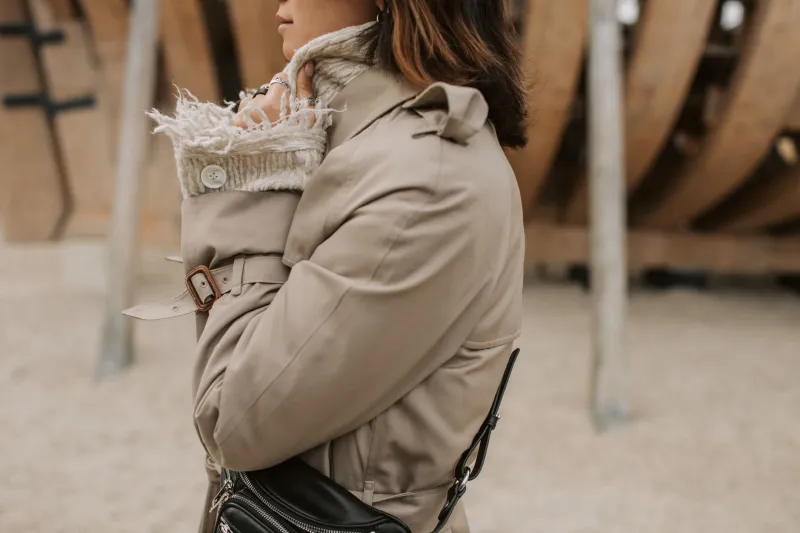
A big coat is not the problem. The problem is the bit at the neck. By mid-November, most of us have a coat with enough volume to house a small family, and a scarf that has been looped twice out of habit since the first cold morning. The result is warm, yes, but it can also make a soft, cocooning silhouette look like a pile of lovely fabric with no beginning or end.
The scarf knot is a small styling decision with a disproportionate effect. It changes where the eye lands, how much heat stays in, and whether an oversized collar looks intentional or simply crowded. Here are three knots worth learning for a British winter, plus the fabrics that hold them best.
Start with the collar, not the knot
Before you tie anything, look at the coat. A cocoon coat with a soft, rounded collar and a generous neckline has enough going on. A tight knot right under the chin will fight it. A flat collar or a collarless coat can take a higher, closer finish. As a rule, the bigger the collar, the lower and looser the knot should sit. You want the scarf to settle into the coat, not perch on top of it.
Width matters too. If the scarf is wide, fold it lengthwise first. A 60cm-wide blanket scarf tied at the throat will always look bulky; folded to roughly 30cm, it behaves. The same scarf can feel like a different accessory depending on whether it is bunched, folded or left open.
Knot one: the once-around
Best for: fine-gauge merino, cashmere, soft lambswool. Not for: thick cable knits.
Drape the scarf around the back of your neck so one end is much longer than the other. Wrap the long end once around your neck, bringing it to the front. Tuck the shorter end under the wrap and let the longer end fall. Adjust so the wrap sits close but not tight, with two fingers of room.
This is the knot for a school run, a bus queue, a drizzly walk to the station. It keeps the chest flat under a big coat and gives a clean vertical line. If you run hot, loosen it by pulling the wrap down a little rather than unravelling the whole thing. It is also the easiest knot to adjust one-handed when you are carrying a bag and a coffee.
Knot two: the low cross
Best for: brushed wool, alpaca blends, wide blanket scarves. Not for: very short or very slippery scarves.
Open the scarf out and drape it across your back so the ends come over your shoulders. Cross them once at the sternum, low down, then tuck the ends under the coat's belt or leave them loose inside the coat. This is less a knot than a soft fold, which is why it suits a big coat. It adds warmth across the chest without adding a lump at the throat.
It also creates a subtle V shape, which can make an oversized coat feel more deliberate. On windy days, tuck the ends inside the coat and let the collar do the rest. This is the knot to reach for when the scarf is the best thing you own and you want to see more of it.
Knot three: the soft slip knot
Best for: long, fine wool and cashmere scarves. Not for: stiff, thick or shiny fabrics.
Fold the scarf in half lengthwise, drape it around your neck with the loop on one side, and pass the loose ends through the loop. Tighten gently, then loosen again so it sits just below the collarbone rather than under the chin. This is the neatest of the three, and the one that works best with soft tailoring: a wool coat, a longline blazer, a tidy knit underneath.
It gives a compact finish and keeps the scarf out of the way when you are carrying a bag or holding a coffee. The trick is not to pull it too tight. A slip knot should look like it happened, not like it was engineered. Leave the ends uneven if you want it to feel less formal.
Fabrics that hold their shape
Wool is the easiest place to start because it has grip. Merino and lambswool hold a loop without sagging, and they are warm without being bulky. Cashmere is softer and lighter, but it can slacken over the day, so it suits the loose cross or a very relaxed once-around. Brushed wool and alpaca blends have a bit of halo and enough texture to stay put in a low wrap. Avoid shiny, slippery fabrics if you want a knot to stay where you put it; silk is lovely against the skin, but it will slide.
If you are buying a scarf specifically for knotting, look for a length of around 180-200cm and a width you can fold. Anything much wider is better draped than tied. A scarf with a little texture will always be more forgiving than one with a high sheen.
The colour question
With a big coat, the scarf is often the first thing people see. A tonal scarf keeps the whole look quiet and column-like; a contrast scarf draws the eye up and can make a simple outfit feel considered. If you are wearing a patterned coat or a strong collar, keep the scarf plain. If the coat is plain, you can afford a check, a stripe or a soft texture. The knot itself should not compete with too much pattern. One point of interest at the neck is usually enough.
The door test
Before you leave, do three things. Turn your head from side to side. Lift your arms as if you are reaching for a top shelf. And check that you can loosen the scarf with one hand while wearing gloves. A knot that fails the door test will be undone by the time you reach the bus stop. The best scarf knot is not the most complicated one; it is the one you can adjust in a draught, on a warm bus, and in the doorway of a pub without needing a mirror.
A big coat already has presence. The scarf's job is to finish the neck, not to add another headline. Choose a knot that sits low enough for the collar, use a fabric with a bit of grip, and leave enough length to move. Then let the coat do the talking.